Sunday, 12 February 2012

Snow flying

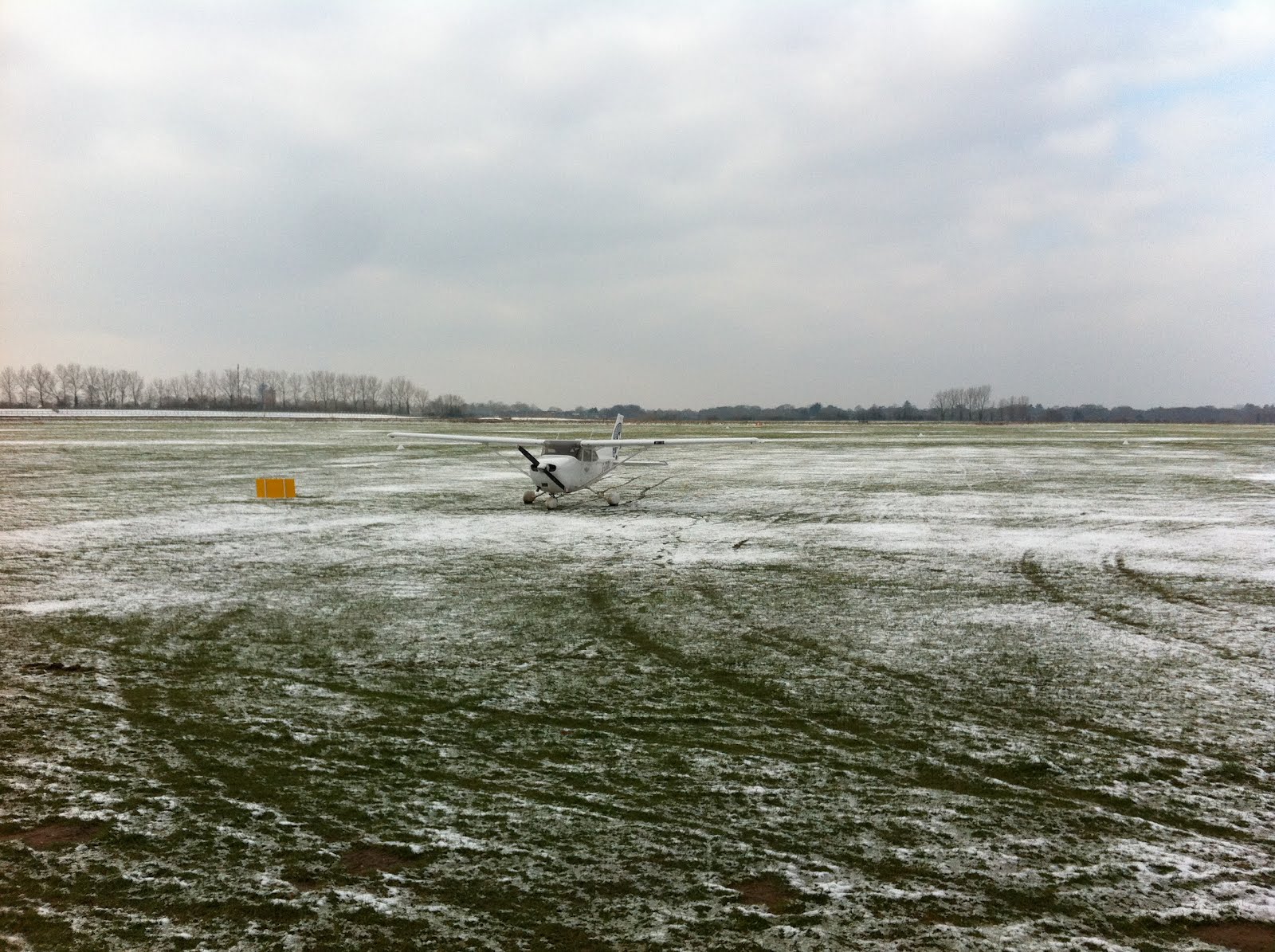
On climbout from Goodwood looking south-west,compared to some places in Europe we had very little snow here!

I've been fortunate this winter, as so far I have managed to fly six times since Christmas whereas this time last year I was virtually grounded from mid-December right through to early March! So all this flying has been meant great progression in my PPL. I'm nearing completion of my solo navigation flights aswell, with the dual and solo qualifying cross country flight to follow soon. Since my last post I have flown navigation flights both solo and dual to Whitchurch, Haslemere and Burgess Hill. All these locations are within 40 miles of Goodwood, so nothing 'long haul' compared to when I undertake the cross country trip which requires around 150 nautical miles round trip.
Inbetween the longer trips we have covered crosswind circuits, where I experienced the full effect of a crosswind, thanks to the gusty conditions. There is something quite unnatural about pointing the nose of the aircraft 30 degrees of the centreline of the runway in order to offset the crosswind from either the left or right,but hugely rewarding to get the aircraft back on the ground!
Taken during a solo nav flight!!

The last two lessons focused on instrument flying, which teaches you the basic requirements to fly the aircraft with reference solely on the instruments as your reference to the outside world is completely cut off, by flying 'under the hood'. An aviator's blind fold in simple terms! I found this exercise very enjoyable but also very tiring, especially when your eyes have to focus on many instruments simultaneously and to interpret them

Thursday, 13 October 2011

PPL Training update


As the summer has now passed, I feel it can be summarised as alot of good progress in my PPL training. Flying around eight times in August without the weather cancelling any of them ( I will pay for that come winter!) and seeing the Spitfire on many occasions-superb.
I am now well into the navigation phase of the PPL syllabus, with many trips planned for the upcoming months. My first taster was the flyout to Duxford, although not a typical PPL navigation lesson, it was a good opportunity to work with the autopilot.

Climbing throught the thin misty stratus we were greeted with this magical view

So far we have covered radio navigation using VOR stations ( VHF Omni-directional Range) which are basically large compasses on the ground with 360 degree segments (bearings ) and you would fly these bearings to or from a VOR station whilst enroute to a destination. A VOR display in the aircraft will show the pilot if he/she is accurately following this bearing and if flying towards or away from the station. I'm sure you would appreciate that this is a very basic description of these radio stations and so have left out alot of the more technical knowledge!

No thats not the plane I fly! Just an illustration of low level flying. Picture courtesy of Chris, one amazing talented amateur photographer
Click here to see more of his work https://picasaweb.google.com/100603098187399900823

We have also covered low level flying and low level (bad weather) circuits. As a comparison I normally fly at 1200ft in the circuit and around 2-3000ft when flying in the local area. Low level flying takes place at around 800ft with 10 degrees of flap ( to give a better forward view) and 80 knots airspeed, and yes, the view is pretty decent when your that low-scudding over the terrain. Its great fun, especially in the circuit where you seem to be airborne literally for 2 minutes. Things happen very fast, so unsurprisingly I found it quite demanding.

Why do we fly low level? Weather. If the weather deteriorated very suddendly and the cloud base lowered to around 1000ft a low level circuit would be necessary to assess the landing area and get down to terra firma promptly and into the flying school clubhouse for tea and cakes!

Thursday, 6 October 2011

Perspectives from the Revival


Just a small selection of some favourite aviation related shots from the Goodwood Revival back in mid September.

The Boeing B17 Flying Fortress 'Sally B'- one of the largest aircraft to land at Goodwood


Hawker Fury MkI

Starstruck! This aircraft, a Supermarine Spitfire Mk IX 'MH434' starred in the 'Battle of Britain' film


Wednesday, 14 September 2011

Duxford fly out

The fleet before the launch to Duxford

At the beginning of September my aeroclub were organising a flyout to Duxford airfield, home of the American Air Museum and many others and served as an RAF and USAF airbase in the world wars. It was a great all round trip for me-to fly up, watch an airshow, gawp at some classical and not so classical aircraft and fly home...(not to mention the lunch provided!)

First introduction to instrument flying! The ribbon like stripes is the motion of the propeller seen through the camera lens

The visit coincided with the Duxford Air Show celebrating the 75th anniversary of the splendid Spitfire. Seven of them took to the skies shorlty before the end of the show and put on a stunning display, what I really enjoyed about it was the aircraft were rarely flown in formation with one another, more of a scattered, 'dog-fight' like display which was so skillfully flown and incredible to watch.


Vickers Super VC10...genius

One of my favourite aircraft is the Vickers Super VC10. I was able to get close to this amazing machine and even board it. I felt proud to board the largest long range airliner built in Britain. Its high subsonic speed meant it was capable to fly into the 'hot and high' airports of Africa and was able to land on many short runways-which was very useful for the developing airports of the late Sixties,early Seventies.

Inside the Air Space museum which houses aircraft like the Avro Vulcan bomber,Concorde and a DH106 -Comet 4 among many others


Then it was time to head back to the aircraft and fly home. Our route took us south towards London (avoiding the controlled airspace with a good safety margin!) then east across the Thames ( Tilbury,Dartford) then past and around Gatwick to make an evening arrival into a quiet Goodwood. It was a great opportunity to experience cross country navigation and witness the operation of the autopilot (Garmin 1000) -such a clever piece of kit. Its a great aid to ensure safety and ease pilot workload, not an excuse for the pilot to catch forty winks whilst the sprites in the autopilot do all the work, a false view often held by the non flying public!

Flying home, crossing the Thames at QE2 Bridge, with a misty silouhette of London in the background. Honestly that was a magical sight...oh how I love flying!

Sunday, 4 September 2011

737 sim ( FULL FLIGHT MOTION! )


A second opportunity to fly a simulator presented itself on Wednesday so naturally I was there like a shot. This time it was a 50 ton Boeing 737-300, part of the 737 'classic' family. Our group did a brilliant job, we spent half an hour each as Pilot Flying (PF) and Pilot Monitoring (PM) the role of that job basically involves setting target speeds and headings in the Mode Control Panel, operating the flaps and landing gear etc. One guy in our group flew the aircraft as if his limbs were just and extension of the flying controls-holding the altitude and speed dead on. Amazing. He claimed he had never flown a simulator before...yeah right! I thoroughly enjoyed it, found the whole experience really beneficial, felt really privileged to be part of it, I am so extremely grateful to our organiser. The motion recreated by the six hydraulic legs of the sim pod is utterly incredible. The acceleration and deacceleration and four motions of flight is identical to the 'real' heavy metal that hauls us from A to B and you soon forget that in reality your still attached to terra firma by six hydraulic legs, not flying a circuit around Gatwick at 3000ft!

Wednesday, 3 August 2011

737 sim

A recent visit to an FTO (Flight Training Organisation) gave our group of three wannabee pilots an opportunity to fly a Boeing 737-700 simulator. What a brilliant experience. I found it hard work-realising this aircraft does not fly like a Cessna 172! It was easy to ignore the flight instruments (like the attitude indicator-displaying the attitude of the aircraft nose and wings in relation to the horizon) and believe you were flying straight and level visually when in fact the nose was pointing downward resulting in a gentle descent! However it was a brilliant experience and one I'm very grateful for, I just knew that I wanted to do more of it in the future.

A Boeing 737-400 on final approach to Runway 26L at Gatwick

We each flew a circuit from Gatwick's runway 26L lasting around 10minutes. None of our 'attempts' at landing were brilliant, but indeed safe! Some practice there needed I think. Luckily I have another chance to fly in a Boeing 737-300 simulator at the end of August, cant wait, till then back to flying the marvellous little Cessna.

Thursday, 21 July 2011

Flying without flaps

Been making good progress with further solo flights, consolidating what I have learnt so far whilst building experience and flying hours. Flapless approaches result in a much shallower descent angle and require small power changes-because of the absence of flaps which create drag and steepen the descent path. Glide approaches are more or less the opposite-steep descent path when flap is selected and a might tighter circuit flown around the airfield. Its a brilliant exercise for practising judgement-when to cut the throttle, is the aiming point within gliding range? how will the wind affect the gliding range? which is an airspeed which will give you the greatest gliding distance available.

Up close and personal to a PC12 NG

A recent avaition exhibition held at Goodwood gave me the opportunity to nosey around some fabulous aircraft-perhaps the Rolls Royce's of turboprop business aircraft. I had the chance to hop on board the Beechcraft Kingair C90GTX, Beechcraft Bonanza G36 and a PC12 NG. I dont think my income would allow me to own one of those, but I certainly wouldnt mind flying any of them one as a commercial job!

The Reds making the usual 'impressive' visit